Monday, January 30, 2012

What we carry in our PFDs

Our last post about PFDs resulted in a number of queries via Facebook and email: "So what do you carry in your PFDs?

What's inside each of our pockets: Sharon (left) and Alec (right).
As we mentioned, this is a topic we recently researched through interviews with a number of notable sea kayak coaches and expeditioners. We had begun paring down on our kit, and we wondered what other paddlers were doing.

You can read about what they told us in the Summer/Fall 2011 issue of Adventure Kayak Magazine. What we carry depends considerably on where we are going and what we are doing. But here's what we nearly always carry in and on our PFDs. (We might add items in certain situations.)
  • VHF radio
  • waterproof camera
  • whistle
  • compass
  • white light
  • strobe
  • knife
  • snack
  • sunscreen
  • lip balm
  • grease pencil
  • very small first aid kit
  • very small boat repair kit
  • watch
And some personal things:
Alec: back-up reading glasses, hair ties.
Sharon: nose clips.

View number two, with everything spread out.
Some people carry a hydration pack, which is a convenience but adds considerable weight and bulk. That can put strain on your back and shoulders.

We were curious what our kit weighed, so we put it on a scale.

Alec's kit weighs two pounds (32 oz.), without the plate.
Our philosophy for whether something belongs in/on our PFDs or in a day hatch is this: If we are likely to need it while we're on the water, and if it isn't a burden, it's in our PFDs. But if we can reasonably expect to stop and get something from a day hatch, it can stay there.

Carrying more kit does make a PFD heavier and bulkier, which is hard on your body, diminishes flexibility, weighs you down and makes it harder to self-rescue. Those are safety considerations. But needing something you can't access is also problematic.

Like everything else, there aren't any cut-and-dried answers. It's a judgment call. But it's a good idea to reconsider what you're carrying each time you go out and adjust it for the expected situation.

So what do you carry in and on your PFD?

Friday, January 27, 2012

Product review: Kokatat MsFit Tour and Ronin Pro PFDs

Eventually, even the best gear wears out. After six years of heavy use and exposure to the elements, the fabric on Alec's Kokatat MsFit Tour PFD was deteriorating, the retroreflective tape wasn't retroreflecting, and the zipper tabs were gone from the pockets. Sadly, it was time to replace it.

Nothing lasts forever, not even a well-made PFD.
We think pretty differently about some aspects of sea kayaking than we did six years ago, so this was an opportunity to consider whether a different PFD might be better. We no longer try to stash in them everything we could possibly need if we were separated from our boats and far from shore. In fact, we try to carry as little as possible for the conditions in which we're paddling. No more flares, signal mirrors, hefty first aid kits, and excessive food and water. Like many of the coaches and expeditioners we interviewed for a Summer/Fall 2011 article in Adventure Kayak Magazine, we now consider it a hazard to be overburdened with gear, so we try to carry only the essentials and ensure that many items serve multiple purposes. If we need more than that, we've really screwed up.

But some things haven't changed. Kokatat still offers terrific gear that's made in the US and backed by excellent customer service. And the MsFit Tour is still the gold standard among PFDs--another observation we made while researching our article, "The Right Stuff." So we decided to try out the Ronin Pro, an attractive vest with only one big pocket because it is designed for whitewater paddlers, and the new MsFit Tour.

The new Ronin Pro (left) and MsFit Tour (right).
Alec was the only one of us in the market for a new PFD, so we got a small/medium Ronin Pro (the smallest size for that model) and a medium MsFit Tour. Both fit Alec, who is 5'4" and 140 pounds; neither was small enough for Sharon, who is 5'1" and 110 pounds and was therefore relegated to documenting the product testing.

The new MsFit Tour features a clever pouch above the lash tab so a knife can be tucked in.
The new MsFit Tour boasts some improvements over the old one. The Gaia PVC-free foam feels comfy and broken in when it's brand new, and the zipper tabs are larger and sturdier. The two side pockets are slightly larger and have an extra zippered pouch on them. The lash tab has been moved up and the fabric pouch on the shoulder extended down to provide an ingenious spot to tuck a knife. No more intimidating students or losing $60 knives!

The Ronin Pro features exceptionally large cut-outs around the arms.
The Ronin Pro is also impressive. Like the MsFit, it is comfortable, solidly built and very adjustable. The cut-outs around the arms are larger, providing more freedom of movement, and there's foam underneath the side straps, offering additional protection from side impacts.

Alec in the Ronin Pro. A paddler with a short torso fill find it especially bulky over the stomach.
But the Ronin Pro has some down sides, at least for a paddler of Alec's size. There's a lot of additional foam on the chest because US Coast Guard regulations require Type III PFDs to have 15.5 pounds of buoyancy, and if you remove some foam from around the arms, you have to put it somewhere else. For a paddler with a short torso, this means extra foam on the stomach, where it gets in the way during self-rescues. In addition, it was impossible for him to wear a tow belt beneath it in the front.

A single pocket sounded like an attractive feature now that we carry less kit, but Alec discovered that he was always rooting around in it to find what he needed. Having three pockets, even if they aren't full, is better for staying organized. And there was no place on the Ronin to carry a VHF radio.

The MsFit has ample room in the two side pockets for more than enough gear, a designated radio pocket, and a knife pouch. (No, that's not the knife we'd actually carry.)
The MsFit, by contrast, offered plenty of external pockets, that snazzy new knife pouch, and an internal pocket for a grease pencil and glasses. Even though that pocket can only be accessed by opening the zipper, internal buckles keep the PFD safely secured. The slimmer profile was better for rescues, too.

In the end, Alec chose to stick with the MsFit Tour. It's simply better suited to sea kayakers, and especially for guides and instructors, who need to carry a certain amount of kit in an organized manner on their bodies.

Some day, we hope someone will figure out a way to add buoyancy without bulk. Or perhaps over time we'll discover that we need to carry even less kit, or that PFDs need less foam. Until then, the MsFit seems to offers an excellent combination of  fit, adjustability, workmanship, pocket configuration and other features for sea kayakers. Sometimes, like Dorothy, you go out looking for your heart's desire only to find that you had it in your own back yard.

Tuesday, January 24, 2012

The poetry of Lake Michigan in winter

These fragments I have shored against my ruins. --T.S.Eliot, The Waste Land
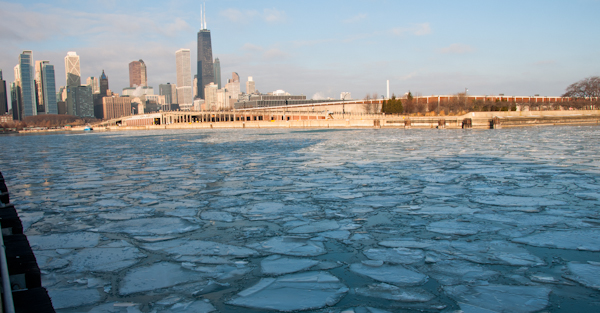
The lake looks like a mosaic now.

A mosaic is a conversation that takes place on surfaces.
A mosaic is a conversation with light, with color, with form.
A mosaic is a conversation with time. 
           --Terry Tempest Williams, Finding Beauty in a Broken World

Sunday, January 1, 2012

12 New Year's resolutions for paddlers

If you've outgrown your drysuit, go ahead and resolve to lose some weight. Otherwise, try these on for size and choose the ones that fit.

In 2012, I resolve to...

1. Work on skills that don't come easily to me.

2. Seek out a mentor who can challenge me in my long-term development as a paddler.

3. Join organizations that protect the environment.

4. Introduce kayaking to someone else.


5. Complete a risk assessment every time I go out on the water and file a float plan.

6. Learn to repair my boat and gear (or at least some of it).

7. Engage in a thoughtful debrief after each paddle to learn from my experiences.

8. Support my local paddlesport shop as much as possible.

9. Practice rescues in the conditions and seasons in which I paddle.

10. Learn to tie a new knot.

11. Learn a related body of knowledge (e.g.wilderness first aid, leave no trace, meteorology).

12. Paddle in unfamiliar waters (preferably outside my region).

We hope 2012 is a happy, healthy year that fulfills all your paddling desires.

Best,

Sharon + Alec

Thursday, December 29, 2011

How to become a better paddler

No matter what your passion, there's a point at which you're likely to plateau. That may be OK; perhaps you've become proficient enough to accomplish everything you desire. But for those who are dedicated to continued improvement and have ambitions as coaches, expeditioners or higher-level paddlers, plateaus aren't acceptable. We aren't content to see our skills and knowledge top out. We want to become better paddlers.

Leon practicing rescue maneuvers.

While we were on Orcas Island with Shawna Franklin and Leon Somme, we talked about the path to becoming an expert. It is, to paraphrase them, a function of hard work, deliberate practice, and guidance from a coach who offers constructive, honest feedback.

They shared with us an 2007 article from the Harvard Business Review, "The Making of an Expert" by K. Anders Ericsson, Michael J. Prietula and Edward T. Cokely, which summarizes research supporting the idea that outstanding performance is not so much a function of innate talent as it is a product of methodical, challenging practice and thoughtful, critical coaching.

Shawna challenges herself by surfing a wave while sitting on her deck.
For higher-level coaches like Shawna and Leon, this means finding hard things to work on and seeking out mentors who point out their weaknesses, even when that type of feedback is uncomfortable. The same is true for all of us, no matter what our level. We'd often prefer to keep working on the skills we already have and hear others affirm our accomplishments. But that's not the path to improvement.

While we were at Deception Pass, we saw this approach in action. After allowing us to warm on an eddy line, they suggested we try increasingly challenging moves as we crossed over into the current: edging without bracing, exiting with a cross-deck rudder, returning to the eddy as quickly as possible, rolling and static bracing on the eddy line, and self and assisted rescues in the current and whirlpools. They gave different challenges to each of us, ratcheting up the difficulty as we demonstrated we were ready for more.

Seth exits an eddy with a cross-deck rudder.

According to Ericcson, Prietula and Cokely:

  • "Deliberate practice involves two kinds of learning: improving the skills you already have an improving the reach and range of your skills." 
  • "Genuine experts not only practice deliberately, but they also think deliberately...they continuously work to eliminate their weaknesses."
  • "The development of expertise requires coaches who are capable of giving constructive, even painful feedback. Real experts are extremely motivated students who seek out such feedback."
This is true for becoming a more skillful and knowledgeable paddler as well as becoming a better coach or guide. Improvement is less a matter of innate ability than it is about willingness to work hard, seek challenges, and accept and act on knowledgeable critiques.


Alec and Sharon practicing deliberately.

"Before practice, opportunity, and luck can combine to create expertise, the would-be expert needs to demythologize the achievement of top-level performance because the notion that genius is born, not made, is deeply ingrained." --Ericcson, Prietula and Cokely


Tuesday, December 27, 2011

Feeling like the Maiden of Deception Pass

The Maiden of Deception Pass, after her transformation.
There's a Salish legend about the Maiden of Deception Pass, who encounters a handsome (though "damp and chilly") young man who lives in the depths of the ocean. Every time she goes to the shore, he reaches out and holds her hand. Long story short: After many such encounters (and disapproval from her family, which later yields), she agrees to move in with him.

Every time we visit the Pacific Northwest, we feel likewise torn between our roots in the midwest and the many allures of this area. We are tugged by the beauty of the land, the profundity of the ocean, the phenomenal paddling opportunities, and our wonderful friends in the area.

Jeremy on a hike around Mountain Lake in Moran State Park on Orcas Island.

Lunch with Shawna and Leon during a day paddle through the Wasp Islands.

Trees, water, trails....sigh.

Sigh.

Toto, we aren't in Chicago anymore.

Tuesday, December 20, 2011

Back at Body Boat Blade, Part 1: Deception Pass

We're back at Body Boat Blade, on Orcas Island, Wash. with our friends Shawna Franklin and Leon Somme. Shawna and Leon recently released a new Sea Kayak Rescues DVD, filmed by Bryan Smith, a dramatic and instructive guide to assisted- and self-rescues in flat, dynamic and rough water. Some of the filming was done in Deception Pass, a place we've long heard about and were looked forward to visiting. 

The Orcas Island ferry dock before dawn.
Getting there meant catching the 6:45 a.m. ferry so that we could arrive during slack tide. The day's max ebb was going to be 7.1 knots at 1:08 p.m., and we wanted to have time to play in the building current before experiencing the full force of the ebb. 

Shawna and Seth paddling toward the bridge.
Compared to Chicago, the air and water were warm--both in the mid- to upper 40s. We paddled past cliffs and barnacle-covered rocks, noticing how the bull kelp indicated the direction of the current. We stopped in an eddy near the bridge, where the eddyline was growing stronger by the moment. 

The group arrives in the eddy.
We spent the better part of the day here, practicing eddy turns and ferries as well as rescues in the current. As the current built, so did whirlpools and overfalls downstream. We tried to ride the upstream tails of the whirlpools to reattain lost ground, and sometimes just rode them around in circles. 

Shawna spins on the eddyline.

Seth uses a crossbow rudder to turn as he reaches the green water.

Sharon rides the wave at the top of the eddy.

Leon executes the "deep diggity dig."

Alec rides a wave.
We spent most of the day in this one spot. As the current diminished, the features changed. Eventually it was time to return to our cars, load up and head for Anacortes, the town with the ferry dock and plenty of pubs. 

Back at the beach at the end of the day.
There's a quote from Isak Dinesen in the Body Boat Blade shop: "The cure for everything is salt water...sweat, tears, or the sea." As we traveled back to Orcas in the dark, we felt cured indeed.

Sunday, December 11, 2011

Complications of cold-weather paddling

Facility closed; lake wide open.
Yesterday, we met our friend Keith Wikle at Portage, Ind. for a paddle along a portion of Indiana's notorious heavy industrial shoreline. The air was below 20 degrees and the winds were forecast to remain 15 to 20 knots out of the southwest, so we dressed and planned accordingly. Our kit reflected a sense of caution.

Cold-weather kit includes items we always carry -- food, water,  first aid, boat repair, cag, blanket, VHF radio, cell phone, spare paddle -- as well as tea, hot water, spare clothing, emergency shelter, pogies, and a deck light.
Nonetheless, we questioned how long we'd stay on the lake. We felt the cold through our drysuits and thermal layers, and it was nearly impossible to keep our toes warm.

After assessing the risks and doing a calorie-to-fun calculation--a mode of decision-making we learned from Scott Fairty of Geneva Kayak Center--we got on the water and paddled out onto the lake. As soon as we were moving, we kept warm. The winds were more or less at our backs, so we planned to turn around less than half way through our four or so hours of time on the water. The rocky breakwall was just beginning to ice over for the winter.

Rock meets ice meets water.
We reached the power plant just west of the Indiana Dunes National Lakeshore, where the warm water outflow raised the temperature of the nearshore water from the high 30s to what felt like about 70 degrees. Steam rose eerily from the surface.

Steam rising where warm water from the power plant meets cold air. 
A few wave sets rolled in, allowing us a rare warm-water surfing opportunity on an otherwise cold day and lake.

Keith paddles back out after a ride to the shore. 
We turned around here, expecting a longer trip back to Portage. The winds had picked up, gusting now to 26 knots. Although the air temperature was at its peak -- about 23 degrees -- the wind chill was about 10 degrees, and we felt it. Our gear began to ice up. Our spare paddle blades, short tow and deck lines, and spray skirts were coated with ice. Icicles hung from our hat brims; ice clumps dotted our drysuits. Things that were formerly pliable became stiff. We were confident in these conditions, but we talked about how hard it would be to execute an efficient rescue with our slippery boats, chilly fingers and ice-encrusted safety gear. 

Things that are usually pliable, like this neoprene spray skirt, were stiff with ice.
The final stretch was less than pleasant. The wind had picked up; the sun was lower on the horizon; the wind chill made it feel as though the temperature had dropped. We were determined to get off the water before dark, and we knew we would feel even colder if we stopped paddling hard.

Dry land and cold fingers.
Over dinner, we reflected on our day. We were glad we went out. The lake was beautiful. We had assessed the risks and planned accordingly, allowing us to push our limits without getting into trouble. But we decided this was as cold as it would be safe for us to paddle. Between the hazard of hypothermia and the  difficulty of doing otherwise simple rescues, even benign conditions are potentially hazardous when the weather gets this cold. 


Wednesday, November 30, 2011

Rough water on Lake Michigan's Chicago shore

Steady north winds peaking at 50 knots generated huge waves yesterday. The city closed miles of the lakefront bike path, and the park district deployed vans to discourage gawkers from getting too close to the water. The marine forecast promised waves of 15 to 20 feet . We got just close enough to get these after-dark shots.


Monday, November 21, 2011

Paddling precautions for colder weather

Lake Michigan waves colliding with Promontory Point.
As the air and water get cooler and the days get shorter, we get more comments of the "you're so brave" and "be careful" sort as we unload our boats and prepare to paddle on Lake Michigan.

Sharon dressed for the day.
Is it actually riskier, or does it just feel that way? In one way, it's objectively safer: there isn't any boat traffic. We have the lake to ourselves. Sure, there's nobody on the lake to help if we need assistance, but we're happy to see empty harbors and nothing but water all the way to the horizon. In some ways, we're safer knowing that we're relying only on ourselves and assessing the risks accordingly.

Before setting out on a recent morning, we deliberately assessed the potential risks and our preparedness. There are many good tools for doing this. Our favorite was developed by Shawna Franklin and Leon Somme of Body Boat Blade, and is helpfully posted by Keith Wikle at GoKayakNow.

Here is how we employed this framework on a cold, somewhat windy day in late November.

Weather
Big picture: Stable.
Wind: 15 to 25 knots, and not predicted to increase. Out of the northwest and predicted to shift to the north. Along shore, not off-shore, and shifting on-shore.
Rain/sun: Overcast with possible rain.
Visibility: Good.
Other hazards: Cooler temperatures (high in the mid-40s).
Verdict: Green

Land
Landscape: Mostly hard shoreline causing reflected waves (clapotis).
Outs: Several beaches and harbors along the way.
Landings: Small spilling surf at beaches or easy harbor take-outs.
Wildlife and other hazards: None.
Verdict: Green

Water
Waves: 3 to 5 feet from the north.
Boat traffic: None.
Verdict: Green

Group
Physical strength: Good, but Sharon just had oral surgery and was feeling low energy.
Mental strength: Good, with the same qualification.
Skills: Strong.
Equipment: Both of our sea kayaks were in good condition, as were our paddles and spare paddles. We carried boat repair and first aid kits, rescue equipment, spare clothing, communication and signaling devices, food and water, and hot beverages. Visibility was good.
Health concerns: Only as noted above.
Suitability of group to conditions: Well within our comfort zone.
Verdict: Green with a tinge of Yellow

It can appear time-consuming, but after a while the process of assessing, deciding and packing becomes efficient. We began the assessment at home, where we checked the weather and chose where to paddle partly on the basis of it. When we arrived, we looked at the lake and determined that it did not alter our plans. We decided who was bringing what as we packed our boats. And then on the water, we reassessed how we felt that day. This kind of dynamic assessment helps ensure that your assessment keeps up with changes in information and conditions.

Sharon is out there somewhere.