Saturday, June 25, 2011

Annual trip to Adventure Crafters

The new Adventure Crafters space at CBEC (Chesapeake Bay Environmental Center).
Every summer, we spend a weekend teaching at Adventure Crafters in Maryland, a paddle center with a heavy emphasis on instruction and a loyal following of long-term students as well as a continuous influx of newer paddlers. For us, it's an opportunity to paddle and teach on salt water, try out some of our coaching ideas in a new environment, and reconnect with owner Robert Schrack, his family and the paddling community Adventure Crafters has nurtured.

Robert Schrack in his office at Adventure Crafters.
This year, we arrived early enough to meet Robert at Cape Henlopen State Park in Lewes, Delaware for a day of paddling on the coast, where we were treated to a sweet tidal race. Then we returned for two days of classes in Queenstown, Maryland.

Two students in the "Yes, You Can!" women's class, celebrating a successful assisted rescue.
Somehow, no matter how we bill a particular class, we always end up returning to fundamentals. Students at every level seem to benefit from a review of the essentials of successful paddling: posture, connectivity, torso rotation, edge control, paddle grip and angle, and basic strokes. Small instructor-to-student ratios enable us to address these simultaneously for students with various levels of proficiency.

If all that sounds like work, it shouldn't. We include lots of games and activities--everything from clambering on the deck for balance, to cockpit basketball for maneuvering--to develop skills on a less conscious level. This concept is neither new nor unique to us. We owe a debt to the BCU (British Canoe Union) and a myriad coaches with whom we've worked who've emphasized the importance of games and activities in learning.

We end every visit with a rousing rodeo event, which is just plain fun.

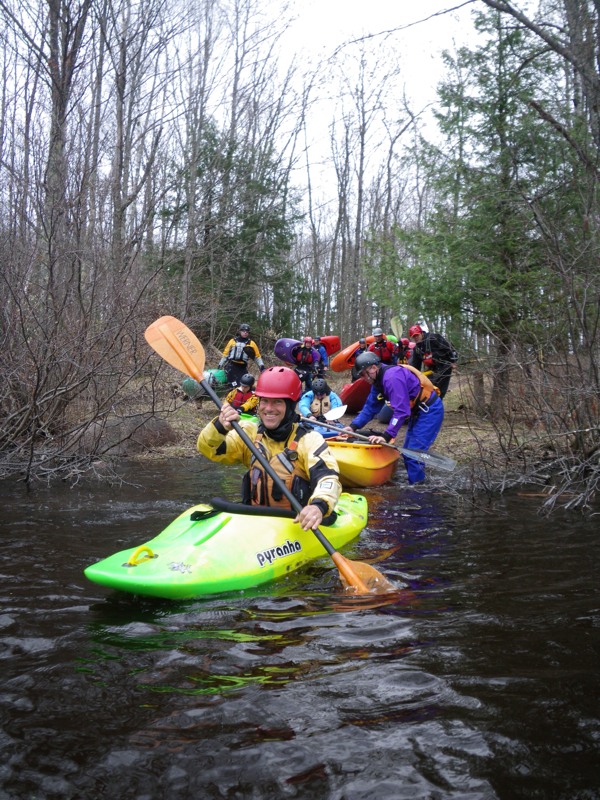
Racing a raft of kayaks, a new rodeo event we learned from Kelly Blades. 
Time flies when you're having fun. We spent our last day paddling again with Robert, reflecting on our classes and spotting eagles and herons along the banks of the Chester River. Long-term paddling relationships are special, whether they're with students, fellow coaches, friends or family members. Those of us who have a mix of all four are fortunate.

Final day of paddling in Maryland. We'll return in 2012.

Friday, June 17, 2011

Brief stop at the Kayak Centre of Rhode Island

The Kayak Centre of Rhode Island in Wickford, RI.
En route from Toronto to Delaware, we paid a visit to Matt Bosgraaf, who wears two hats: inventory manager for the Kayak Centre of Rhode Island, and east coast sales manager for GRO (Great River Outfitters, the east coast importer of Valley and North Shore boats)--two completely separate enterprises. Fortunately, we were able to pry him away from both for a couple of hours on the water. 

A quiver of kayaks.
The Kayak Centre has a large showroom and offers classes, tours, rentals and repairs. The Warsick location carries between 120 and 140 boat models, including sea kayaks, recreational kayaks, sit-on-tops, fishing kayaks, racing boats and more. We took advantage of this extensive inventory to try out a few boats we'd never paddled: the Valley Etain 17.5, the North Shore Polar, and the North Shore Atlantic LV.

Alec and Matt in the harbor near the Kayak Centre.
Switching boats midway through our paddle.
The immediately environment is remarkably diverse. Within 10 miles of the shop, there are all sorts of conditions: calm water, rough water, current, surf, rocks, and even a tidal rip. We didn't have enough time to explore beyond the bay on this trip, but we'll be back. After all, we have another 117 boats to try out.

Tuesday, June 14, 2011

MEC Paddlefest Toronto makes a splash

One beach, two days, 600+ new paddlers.
We just returned from MEC Paddlefest Toronto, an "urban celebration of all things paddlesport related" run by Mountain Equipment Co-op, the Canadian equivalent of REI (more or less). "Celebration" hardly begins to describe this astonishing event. Over the course of two days, Paddlefest offers land and water clinics on sea kayaking, whitewater kayaking, canoeing and stand-up paddling, complete with all necessary equipment, for people who register in advance or sign up on-site. Sponsors and clubs staff informational booths, vendors provide demo boats and gear, kayak polo players shoot baskets, and dragon boats zip back and forth. For two days, Sunnyside Beach is awash in a wide diversity of boats and people.


The master organizer behind Paddlefest Toronto is Liz Burnside, who didn't seem nearly as frazzled as she ought to have been. Chalk it up to some magical alchemy of experience (she's run this event five times before), talent and temperament; the event ran remarkably smoothly.


Liz Burnside, keeping the event on track.
Before the festival began, about 20 instructors took advantage of a "mini instructor symposium" organized by Erik Ogaard, a Paddle Canada Instructor Trainer and head of paddling instruction for the Harbourfront Canoe and Kayak Centre. This provided an opportunity for us to meet some of the energetic Canadian coaches and for all of us to get an instructor update.

David Johnston, fellow coach and blogger, and Keith Wikle's Canadian doppelganger.


Dympna Hayes, the infectiously energetic co-owner of learntokayak.ca.

Michael Pardy, co-founder of SKILS and Senior Instructor Trainer for Paddle Canada (one of his many outdoors and paddling certifications), shared some of his "detection/correction" strategies for helping instructors improve students' strokes. Kelly Blades, who defies description, showed how games can help to develop balance and boat control. 

Erik, ensuring that everyone fuels up.
Michael and Kelly, strategizing about our instructor update.
The fest itself was eye-opening for us. Classes were 90 minutes long, and most students had signed up in advance, paying just $10 for each on-water course and $5 for each land-based course. In defiance of the idea that people who pay less care less, these students could not have been more committed. They showed up in whatever clothing they had -- often nothing more than quick-dry shorts and tops -- eager to get on the water, which was still in the mid 50s. We quickly found them boats, PFDs, skirts and paddles and took off, wondering how long they would last once they got wet. But they were tenacious; they wanted to get everything they possibly could out of each of us. Even our rescue and rolling clinics, during which participants were immersed most of the time, didn't dissuade these avid students.

Many participants lacked appropriate paddling gear, but that didn't stop them.

They spent time working on strokes, rescues, rolling and more.

The concept behind Paddlefest is to introduce people to paddlesports. It's a taster, and its success is best measured in the enthusiasm of the participants and their eagerness to learn more in the future. From every thing we saw and heard, this year's fest accomplished those aims. Hundreds of people discovered the pleasure of getting out on the water in a human-powered craft. That's a pretty hefty accomplishment for one weekend.

Saturday, June 4, 2011

Rediscovering the Chicago shoreline

We recently completed and delivered a presentation called "Paddling in Chicago," a historical journey down Chicago's manmade coastline that explained why and how today's familiar features were created. In the process, we learned things we didn't previously know, and rekindled our own interest in our local shoreline.

Today we returned to one of the places that fascinate us most: the far South Side, where the shoreline is built of cast-off relics from the demise of the US Steel Southworks plant. At its peak, the plant employed 20,000 people and produced beams that were used in the Sears Tower and other skyscrapers. When it closed in 1992, it left behind a pile of twisted steel and concrete boulders, weeds and imporverished neighborhoods.

A peaceful docking spot.
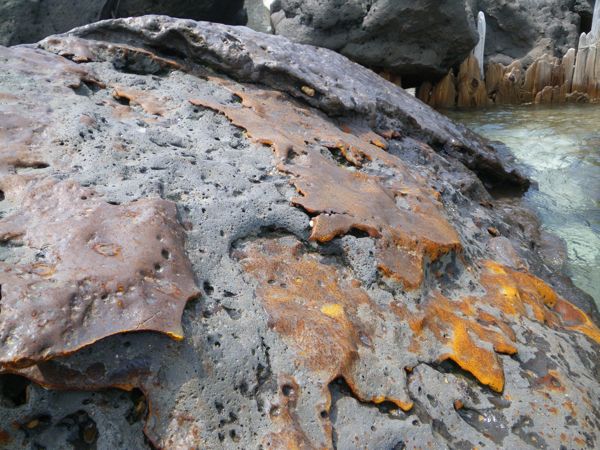
And yet, this section of the shoreline is lovely. The massive slabs of casting material look like volacanic boulders; broken-up hunks of concrete buildings and staircases seem like strangely sculpted rocks.

Elsewhere this might be a lichen-covered rock. Here it is a steel-impregnated casting slab.
A piece of rebar stands in for a sturdy root or belay rope.
That "standing in your boat" game turns out to have a practical application.
Chicago's shoreline is anything but natural, and sometimes we mourn the lack of wild spaces around here. But after industry leaves, nature starts to take over, and there is a pleasing, post-urban quality to this stretch of shoreline. The more we learn about it, the more we appreciate it. 

Wednesday, June 1, 2011

Whitewater, WMCKA, waves and more

Spring finally arrived, and with it a range of pleasing water levels at the Yorkville whitewater course,  the annual West Michigan Coastal Kayakers Association symposium, and waves on Lake Michigan.

Flower blossoms herald the season.
Blame it on the season; we were too busy to post. But not too busy to paddle. We experienced the Yorkville whitewater course at fun levels between 2,300 cfs and 3,600 cfs, as well as the not-fun level of 6,800 cfs, when nearly all the features were washed out and we chose not to attempt a first descent of the sidewalk.

Hannah, back from college, reunited with her kayak.
We also had the pleasure of attending the grand opening of the whitewater course, now named the Marge Cline Whitewater Course in honor of the Chicago Whitewater Association's "River Mom," who died in 2007. We even got to take the Mayor of Yorkville and a few aldermen down the course in a raft.

The cold start to the spring was caused, in part, by weather patterns that were still bringing cold air to Chicago from the north and northeast. Here that means waves, and we had plenty of autumn-like surfing days early in the season.


By Memorial Day weekend, we were ready for warmer weather, which slowly arrived during the annual West Michigan Coastal Kayakers Association symposium.


The event was abbreviated this year by an afternoon thunderstorm, which kept everyone off the water all afternoon on Sunday. But we had the good fortune to have two stellar fiddlers among us -- sisters Carrie and Emma from the Upper Peninsula -- who kept our spirits up when the weather threatened to douse them.


Next up: the Toronto Paddlesport Festival. Stay tuned!

Thursday, May 5, 2011

Whitewater weekend with Geneva Kayak Center

Alec leads the group onto Section 3 of the Wolf River.
We spent the past weekend at a staff retreat for Geneva Kayak instructors. We pitched our tents in a rustic site near Langlade, Wisconsin, and spent our days doing some swift water rescue training and some whitewater paddling on the beautiful Wolf River. 

Water levels were high, thanks to a combination of recent rain and snow melt. It was running at about 900 CFS, so many rocks lurked just beneath the surface. But at this level, it provided some nice waves, solid eddies and a lot of fun.

Aaron paddles through Gilmore's Mistake.
At this time of year, there's no question about dressing for the water temperature. It was essentially the same as the air temperature--about 40 degrees--and the wind made it feel cooler. But as long as we wore plenty of thermal layers and kept paddling, we stayed warm. 

Scott catches a wave.
The same could not be said of the campsite, where it was difficult to stake our tents in some places because the ground was frozen and strong winds threatened to blow them away. Still, we managed to enjoy a campfire most nights and mornings and practiced tying bowlines and setting up Z-drags. 

When it wasn't too windy, the campfire kept us warm. 
There's a huge value to staff retreats. In addition to the training, they provide opportunities to build camaraderie. 

Haris, Paul and Greg at the campsite.
Jeremy and Emily help prepare breakfast.
Ryan picks blueberries.
And for those of us who paddle sea kayaks more than whitewater boats, they provide an opportunity to have a steep learning curve once again. 

Sharon smiling--a look typical of all of us.

Monday, April 25, 2011

Easter Sunday paddle, with a pleasant surprise

It was a cold and blustery day...
Easter morning dawned overcast but seemingly calm, so we set our expectations accordingly. A 20-mile paddle starting on the South Side, past two of Chicago's water intake cribs, with a stop for lunch at 12th Street Beach, and back again along the shoreline would be pleasant, a nice spring-time warm up for longer paddles to come.

The sky was overcast and the water was calm as we left the harbor.
And, in fact, the winds were a mere 10 to 12 knots--a Beaufort Force 3 to 4--and out of the north. Not enough to slow us down much, but enough to sustain waves of 2 to 3 feet that must have built the previous day, and to create scattered whitecaps. They weren't apparent until we passed the break wall outside the harbor. "Ha," we said. "This could be an interesting paddle after all!"

Not that paddling isn't always interesting, but calm water does tend to get more tedious than the bumpier varieties.

Approaching the second crib.
The trip out, cribs and all, took four hours. The last leg back took less than 90 minutes. Which goes to show that you never know what you'll find until you get on the water. We had looked at the forecasts, the radar, the clouds and the wind speed (the forecast was 5 to 10 knots), and we thought the lake would be close to flat. And to our delight, we were wrong.

Friday, April 15, 2011

Waves building on Lake Michigan

Last night, the wind began to blow out of the north, shifting to the northeast and then to the east at speeds of 20 to 30 knots.

A low pressure system moves in, bringing wind and waves.
Here on the southwest corner of Lake Michigan, that translates into considerable wave heights.

Wind data from a water intake crib off shore.
By noon today, the waves were surpassing the break walls and things were getting pretty chaotic.


At Montrose Beach, one of the best surfing spots in Chicago, the waves were 5 to 7 feet, with clapotis in places adding a few more feet. 


If this front moves through as predicted, the wind should be out of the south tomorrow, and the waves should clean up and provide some good surfing, though the water temperature will still be in the low 40s. Local paddlers are already making plans to take advantage of this early-season surfing opportunity.

Monday, April 11, 2011

Getting up to date on First Aid and CPR

The American Canoe Association requires instructors to be certified in First Aid and CPR--a knowledge base that we've made use of on more than one occasion as coaches. 

In the past, we've taken the two-day Wilderness First Aid (WFA) course offered by Wilderness Medical Associates, and we've long been interested in the Wilderness Advanced First Aid and Wilderness First Responder courses. But with time and money as limiting factors, we haven't yet managed to attain those certifications. 

With our WFA about to expire, we set up a one-day American Heart Association Heartsaver First Aid course with John Browning, an ACA Level 4 Sea instructor trainer, emergency medical technician, and instructor with both the American Heart Association and Wilderness Medical Associates. This set-up allowed John to tailor the usual Heartsaver curriculum to a class mainly comprised of kayak instructors, and to add some additional wilderness and paddling-related elements.

Cap'n Browning, at the helm of the First Aid course.
The Heartsaver curriculum is very urban in its orientation. It's geared mainly toward workplace safety, and assumes a quick response from emergency personnel. By contrast, the WFA course is geared toward guides and outdoors enthusiasts on short trips away from civilization. So while the Heartsaver course emphasizes how to perform CPR (some of which recently changed) and how to staunch bleeding while waiting for emergency personnel to arrive, the WFA teaches participants how to evaluate and stabilize a victim far from help. 

The course was not without its surreal moments. It is taught with the help of a slick video featuring workplace and urban scenarios that are then repeated in a studio by sweatsuit-clad actors. 

Gloves, projector, action!
Even the mannequins seemed sleepy after a full day in a small room. 

Zzzzzzzzz.
There's no question that staying current on First Aid is valuable, and we especially appreciated the additional outdoor content John provided. (His reading list alone was worth the price of admission!) But taking this course motivated us even more to get additional training in Wilderness First Aid, because most of the incidents we encounter happen outdoors.